the hawk-bills
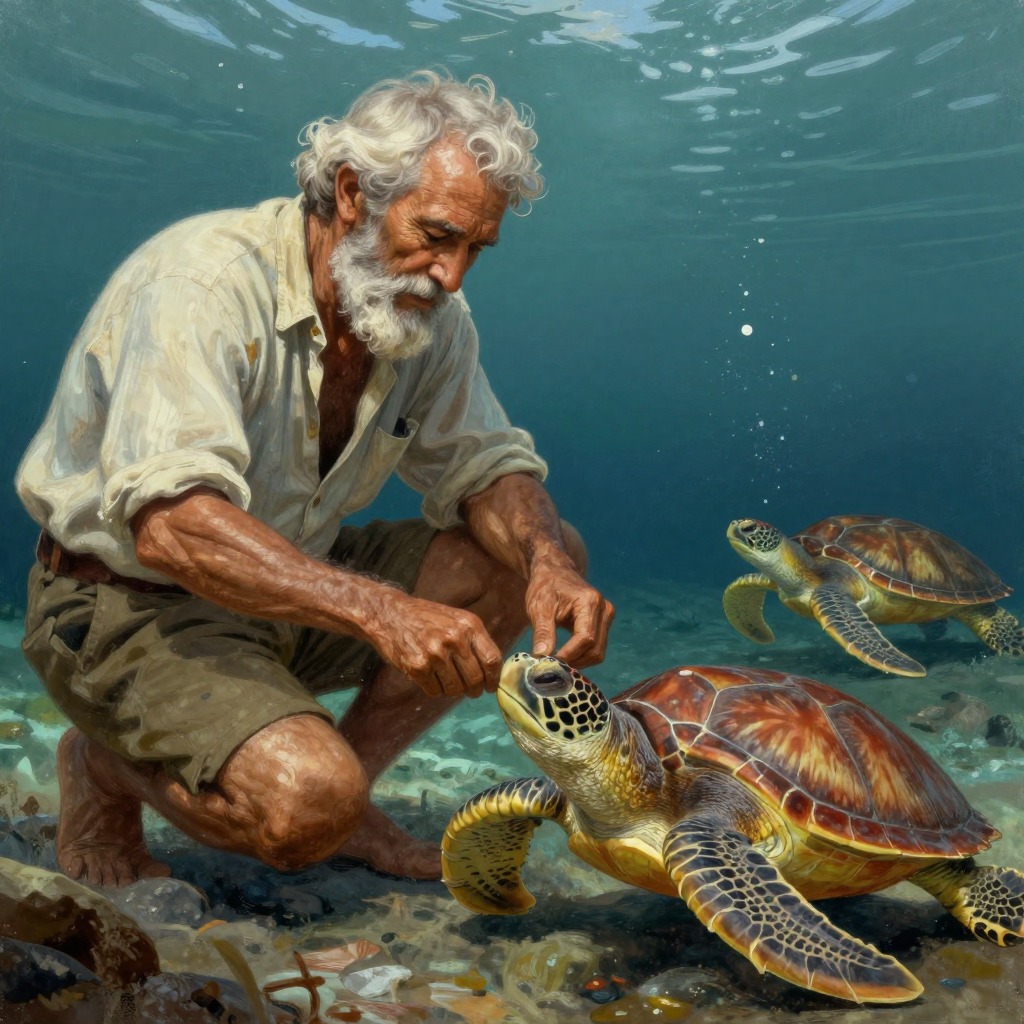
The hawk-bills are a species of sea turtle that Santiago, the old fisherman, holds in high regard, distinguishing them from other turtles he encounters. In the narrative, Santiago's knowledge of and feelings toward the hawk-bills reveal his deep, practical connection to the sea and its creatures, a connection that is both affectionate and unsentimental. He loves the hawk-bills for their elegance and speed and their great value, a sentiment that contrasts with his friendly contempt for the huge, stupid loggerheads, which he finds strange in their love-making and happy in their consumption of Portuguese men-of-war. This distinction underscores Santiago's nuanced, almost personal, taxonomy of the ocean's life, where each creature is judged by its character and utility, not merely by its place in the food chain.
Santiago's Relationship with the Hawk-bills
Santiago's admiration for the hawk-bills is part of a broader, lifelong intimacy with the sea. He has no mysticism about turtles, despite having gone in turtle boats for many years, and he feels sorry for all of them, even the great trunk backs that are as long as the skiff and weigh a ton. This pity is rooted in a shared vulnerability: he notes that most people are heartless about turtles because a turtle's heart will beat for hours after it has been cut up and butchered, and he reflects, "I have such a heart too and my feet and hands are like theirs." This identification with the turtle's endurance and suffering is a key aspect of Santiago's character, linking his own physical trials to the resilience of the creatures he hunts. The hawk-bills, with their elegance and speed, represent a more admirable form of that resilience, a creature whose value is both aesthetic and economic.
The Hawk-bills in the Context of the Sea's Economy
The hawk-bills' "great value" is not an abstract quality; it is tied to the economic realities of Santiago's world. The old man lives in a community where the sea's bounty is processed and sold: the successful fishermen butcher their marlin and carry them to the fish house to wait for the ice truck to take them to market in Havana, and sharks are taken to the shark factory where their livers are removed, their fins cut off, and their flesh cut into strips for salting. In this context, the hawk-bills are a valuable commodity, and Santiago's appreciation of them is that of a skilled fisherman who knows the worth of what he catches. This economic awareness is also present in his thoughts about the marlin he hooks, calculating its potential price at thirty cents a pound and wondering if the great DiMaggio would be proud of him. The hawk-bills, like the marlin, are part of a system where beauty and strength are translated into market value, a system Santiago both participates in and transcends through his personal code.
The Hawk-bills as a Contrast to Other Sea Creatures
Santiago's feelings for the hawk-bills are clarified by his attitudes toward other marine life. He loves to see the big sea turtles eating the Portuguese men-of-war, which he calls "Agua mala" ("You whore"), recognizing their beautiful but deadly and false nature. The turtles, by contrast, approach the men-of-war from the front, shut their eyes so they are completely carapaced, and eat them filaments and all. This act of fearless consumption is something Santiago admires. The hawk-bills, with their elegance and speed, are a more refined version of this turtle-kind, while the loggerheads, with their stupidity and strange love-making, are a comic, less admirable counterpart. This hierarchy of respect—from the noble Mako shark to the hated galanos, from the beautiful hawk-bills to the clumsy loggerheads—reveals Santiago's moral and aesthetic framework for the ocean, where each creature is judged by its behavior, its courage, and its role in the cycle of life and death that he himself is a part of.